
Jiahua Huang 黄嘉华
Email: jiah.huang@foxmail.com
Research Interest
My expertise lies in Machine Learning Systems (MLSys) and resource management, with a specialized focus on enhancing Large Language Model inference through innovative AI methodologies. I am also an SGLang contributor.
I am actively seeking an internship in LLM inference optimization. Please feel free to reach out if you have or know of any suitable opportunities. I’m always open to connecting with professionals in the field.
Education

South China University of Technology, Guangzhou, China
- Ph.D. in Computer Science, advised by Prof. Weiwei Ling, Sep. 2023 – Present

Shenzhen Institute of Advanced Technology, Chinese Academy of Sciences, Shenzhen, China
- Master of Engineering, Electronic Information, advised by Prof. Yang Wang, Sep. 2020 – Jun. 2023

Jiangnan University, Wuxi, China
- Bachelor of Engineering, Digital Media Technology, Sep. 2015 – Jun. 2019
Publications
- [AAAI '26] Experiential Fairness: Bridging the Gap between User Experience and Resource-Centric Fairness in Online LLM Services [paper] [poster] [code]
- Jiahua Huang, Wentai Wu, Yongheng Liu, Guozhi Liu, Yang Wang, Weiwei Lin
- The 40th Annual AAAI Conference on Artificial Intelligence (CCF-A), Accepted on 08 Nov 2025.
- [CSUR '25] On Efficiency, Fairness and Security in AI Accelerator Resource Sharing: A Survey [paper] [url]
- Jiahua Huang, Weiwei Lin*, Wentai Wu, Yang Wang, Haocheng Zhong, Xinhua Wang, Keqin Li
- ACM Computing Surveys (SCI Q1 Top, IF 30.8), Accepted on 24 Feb 2025.
Project
- RONDO: Segment-Level Continuous Batching for Multi-Tenant Flow-VLA Serving — Core execution merged into SGLang main
- RONDO addresses heterogeneous denoising budgets in shared robot inference: whole-trajectory batching blocks new requests, while step-level batching incurs excessive host scheduling overhead. Resumable accelerator-resident execution, completion-boundary segmentation, and dynamic remaining-work bucketing enable efficient regrouping across trajectories.
- Evaluated with pi0.5 on 8 Ascend 910C NPUs, the research system reduces mean serving latency by up to 75.2% relative to Native. In LIBERO closed-loop simulations with 16–32 concurrent robots, it achieves up to 92.3% task success and a 4–5× improvement over serving baselines.
- Completion-boundary batching and resumable execution are available in SGLang (#44634).
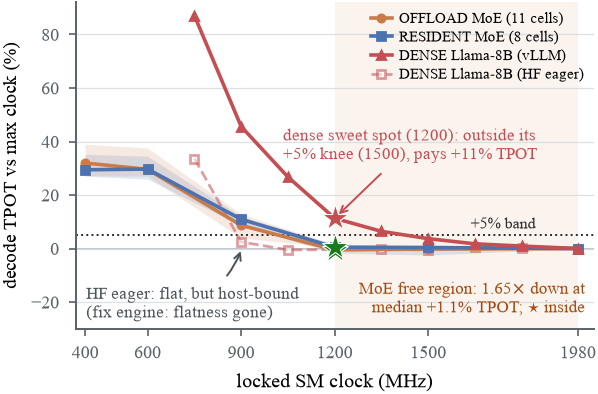
- EcoMoE — SLO-aware energy optimization for offloaded MoE inference
- We identify a thick memory-access wall in MoE decode by combining
SM_ACTIVEvs. NVML utilization mismatch, load ramps, cache sweeps, and byte-level HBM/PCIe accounting, showing that the bottleneck comes from the expert-weight access path rather than low load. - Locked-clock sweeps then show why this wall is useful for DVFS: MoE decode has a broad latency-flat region, while dense LLM decode is much more clock-sensitive and therefore offers far less safe downclocking headroom.
- We identify a thick memory-access wall in MoE decode by combining
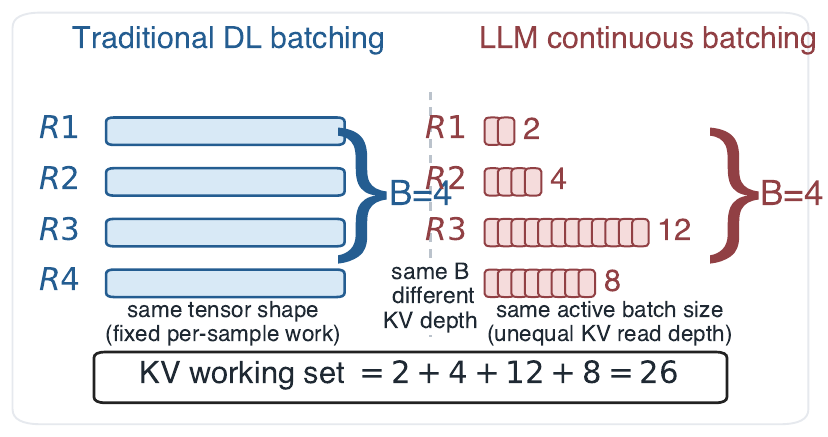
- PACE — KV-working-set-aware GPU DVFS for LLM serving
- We show that decode-time energy in continuous batching tracks the active KV working set, exposing memory pressure that active batch size alone cannot describe.
- Based on this signal, PACE is a lightweight feedforward controller that uses only runtime scheduler state to reduce decode energy while preserving tail-latency SLOs.
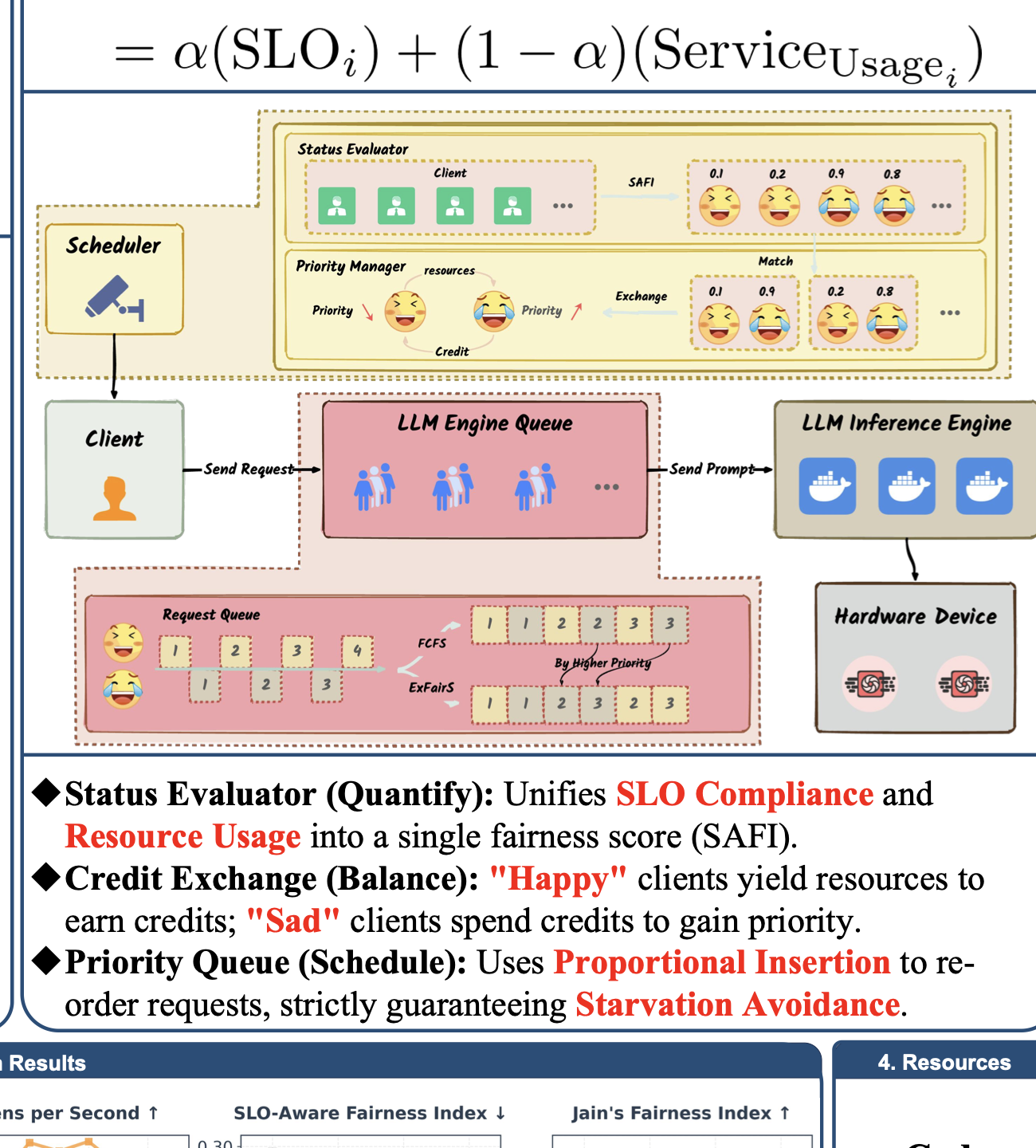
- ExFairS
- ExFairS is a scheduling framework for online LLM services that bridges the gap between system-centric fairness metrics and actual user experience.
- It introduces an SLO-aware fairness score and combines credit exchange with a priority queue to improve user-perceived service quality.
Experiences
Alibaba Group, Hangzhou
- Research Intern, Oct. 2021 – Oct. 2022
Alibaba Cloud, Hangzhou
- Research Intern, Aug. 2021 – Sep. 2021
CCB Fintech, Shenzhen
- Software Engineer, Jul. 2019 – Jun. 2020
Awards and Fellowships
[Siat Digital Institute Outstanding Student of the Year Award]
- Siat Digital Institute, 2022